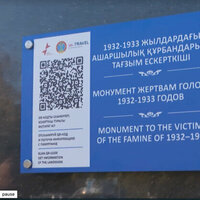


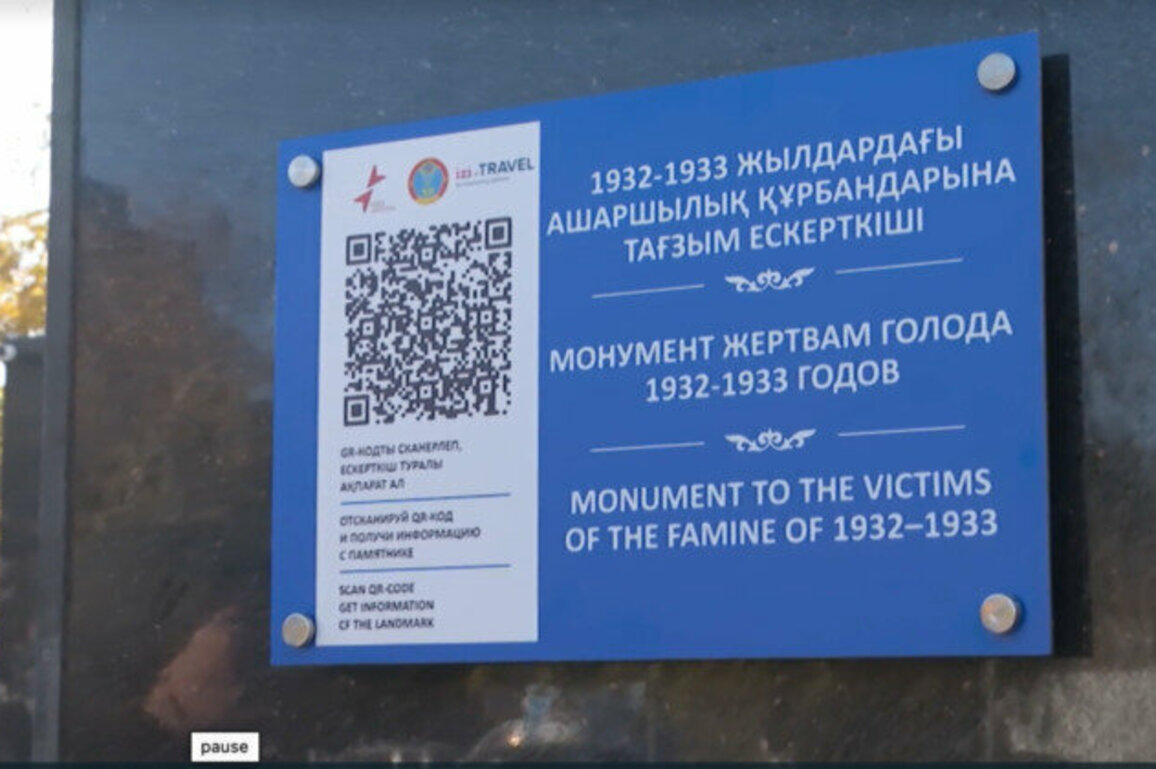
Few noticed when earlier this month city authorities in the Kazakh capital, Astana, quietly replaced a memorial plaque honoring the victims of the deadly famine that ravaged the country in the 1930s.
The original inscription referred to the tragedy as a Holodomor, a term that implies a man-made famine and genocide.
The new plaque in Astana, however, uses the Russian word, golod, meaning famine, a more neutral term that removes the connotation of responsibility.
While the move raised few eyebrows at the time, it has started to catch the attention of many and put the spotlight on a long-standing debate over the famine, which killed at least 1.5 million people -- roughly one-third of Kazakhstans population --marking one of the darkest chapters in the Central Asian nations history.
The Russian inscription on the new plaque uses a much more neutral term for famine that 'Holodomor.'
Over the years, many Kazakh historians, politicians, and activists have called on their government to recognize the famine as a genocide orchestrated by Soviet leader Josef Stalins regime.
But, keen to avoid upsetting Russia -- a close ally and major trading partner -- Kazakhstan has so far resisted such calls.
The word Holodomor itself originates from Ukrainian -- combining holod (hunger) and mor (death or plague) -- and is commonly understood to mean death by hunger or deliberate starvation.
Ukrainians interpret it as denoting a policy of extermination carried out during the 193233 famine in Soviet Ukraine, which is now known internationally as the Holodomor.
Unlike Ukraine, which in 2006 officially labeled its Holodomor a deliberate act of extermination by Moscow, Kazakh leaders have consistently described their country's famine as the tragic result of misguided Soviet policies rather than an intentional crime against the Kazakh nation.
SEE ALSO:
'A Gift To Posterity': Four Men Who Risked The Wrath Of Stalin To Photograph The Holodomor
Now, however, the politics of remembrance embedded in that single word are reverberating in Kazakhstan.
Officials in Astana have offered little explanation for their decision to replace the original plaque. The city administration told RFE/RL in a written response to questions on the matter that the word was changed to ensure bilingual consistency. Kazakh is the country's "state language," while Russian has the status of an "official language."
The change of wording has sparked a backlash on social media, with many crying foul.
One Facebook user, Dastan Abdyrakhmanuly, called it a distortion of Kazakh history and an attempt to conceal the political nature of the tragedy inflicted on the people.
Abdyrakhmanuly and many other Kazakh social-media users have demanded that the word Holodomor be restored.
A Taboo Subject In Soviet Times
In the late 1920s, the Soviet government began forcibly implementing a policy of collectivization for the agriculture sector across the Soviet Union.
In Kazakhstan, the campaign aimed to permanently settle Kazakhs, a nomad nation, and force them onto collective farms. It also involved the mass requisition of livestock -- the main livelihood of the nomads.
By late 1930, drought, disease, and starvation had spread across the Kazakh steppe, killing more than a million people and forcing hundreds of thousands to leave the country.
Historians estimate that by 1933, somewherebetween 1.5 million and more than 2 million people had perished in Kazakhstan during the mass starvation, part of a broader Soviet famine that also affected Ukraine and several regions of Russia. But the subject remained taboo during Soviet times.